THE MAKING OF AN ICON

THE MAKING OF AN ICON

When we fall in love with
an object, it’s rarely
just about how it looks.

It’s about a quality we can feel, a story that moves us and the quiet, lasting value we find in both.


Lately, design has been looking back — not simply for nostalgia, but for connection. Pieces created decades ago are finding their way back into contemporary interiors. Some never really left, while others are capturing the imagination of a generation discovering them for the very first time.
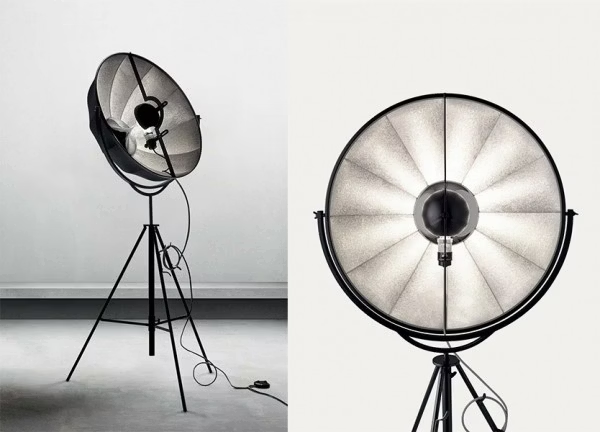
Across interiors, we’re seeing a growing interest in vintage pieces with a story behind them, things made by hand and materials that feel honest. More and more, the ‘why’ behind an object matters — the hands that shaped it, where it came from and the purpose it was meant to serve.

We’ve been here before. More than a century ago, the Arts and Crafts Movement emerged during a period of extraordinary industrial change, placing renewed value on skills passed down, honest materials and the work of human hands. Today, in a very different world, many of those same human values are resonating again.

Algorithms. Automation. Infinite imagery. Rapid trend cycles. Artificial perfection. And at the same time:

Handmade. Provenance. Vintage. Authorship. Natural materials. Character. History. Objects with a story to tell.

The parallel is difficult to ignore. It’s not a rejection of progress, but perhaps a very human response to it. The more abundant the artificial becomes, the more meaningful the authentic can feel.

We’ve seen this instinct elsewhere. Vinyl has found renewed relevance in an age of streaming. In 2025, it marked its 19th consecutive year of global revenue growth. Not because digital music disappeared, but because a record offers something tangible. You choose it. Take it from its sleeve. Place it on the turntable. Lower the needle. Turn it over. Listening becomes a physical ritual again.


The record hadn’t changed. The world around it had.


The same is true of iconic design. The qualities we are drawn to now — authorship, originality, a story worth knowing — were always there. What has changed is how much we’ve come to value them.

When we truly value something, something else happens. We tend to keep it.

When something is made well enough to last, sustainability begins to take on another meaning. It isn’t only about how long an object can physically endure, but whether its value can be sustained too.

What you choose becomes what someone else inherits.

And they may keep it not simply because it belonged to you, but because good design is worth keeping.

We now recognise that authenticity is often born from something deeply human — a passion, an urge, a need, a challenge. Behind every icon is a story worth knowing.

Before the recognition, before decades of hindsight, there was simply an idea and someone compelled to pursue it.

Every icon was once new.

We can’t know with absolute certainty which of today’s designs will become tomorrow’s icons. What we can do is connect with the story that makes us see and feel design differently — creating desire that makes us want to make it part of our own story.

Subscribe to our newsletter
This field is for validation purposes and should be left unchanged.